How a thing becomes inevitable.
This is not a services page. It is the grammar of the work.
Experience
What should a person experience, notice, understand, remember, or do? The medium comes after. Explanation too. If the audience needs a tutorial, the interface is still competing with the encounter.
System
The interesting object is rarely an isolated deliverable. It is the chain: authoring, place, body, media, operators. Dependencies, interfaces, failure modes, flows — held together so the experience can hold.
Interface
Give technology a job, then let it disappear. A system can be extremely sophisticated while the encounter stays simple. Complexity underneath; clarity at the surface.
Deployment
If it cannot install, tour, reset and be maintained, it is not finished. Visitor, technician, stage manager, maintenance: everyone around the project is a user.
Experience first
The starting question is never the tool. I do not begin with “I want to use TouchDesigner” or “this should be VR.” The stronger question is: what should a person experience — notice, understand, remember, do? Only then does the medium become a design decision.
The audience is allowed to encounter something before the system explains it. No unnecessary labels over an underwater animal. No interaction simply to prove a system is interactive. No dashboard when one gesture will do. No technology showcase that competes with the experience.
This is an artistic principle, not only an Azul Vivo rule. Explanation comes second. Interaction is not the same as input.
Interaction is not input
Skepticism toward interaction-as-spectacle: participant moves, particles move. Unless that gesture produces meaning, it does not belong.
A more characteristic act is to observe, discover, remember, affect a shared system indirectly, reveal a hidden relationship, let physical context alter digital behavior, let the system become attentive to the participant.
The question is not always “how can the participant affect the media?” Sometimes it inverts: how does an immersive system influence the body — if we refuse to explain every encounter?
Constraints as material
Venue, hardware, field conditions, budget, audience, operator, travel, bandwidth, safety, environment, install time, distribution. Constraints enter the process early. They are not obstacles to protect a concept against.
The goal is to discover the version of the concept that becomes stronger because it understands reality. An idea that only survives in the lab is not yet designed.
What must remain true
Define a set of targets — from emotional effect to physical perspective — and use them as rules. What cannot be compromised. What the audience should perceive. The physical and operational environment. Then every subsystem is judged against those rules.
This is why artistic and technical decisions speak to each other: both are evaluated against the same experiential objective.
Follow the question
The practice is broad because a question does not stop where a job title stops. If understanding the problem requires code, optics, 3D printing, networking, interaction design, underwater capture, cloud architecture, fabrication, biology or projection geometry, I learn enough of the adjacent discipline to decide and collaborate.
I can carry a project across many domains. The strongest description is not “one-man army.” It is: hold the whole system in my head, build substantial parts directly, and collaborate with specialists without losing the coherence of the experience.
The whole relationship
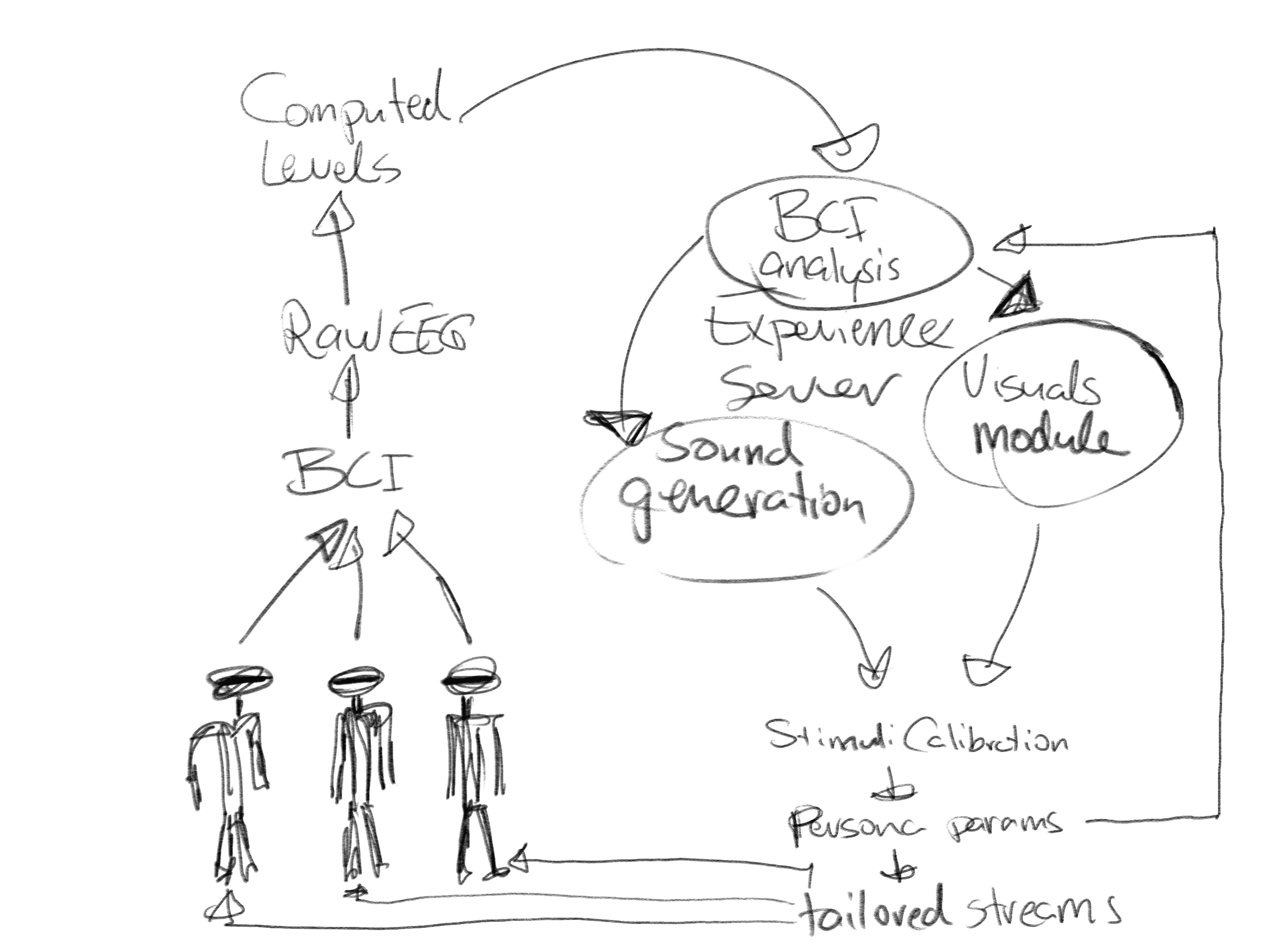
The strongest work is represented as a chain, not a deliverable. OnMove is not “a React frontend.” It is creator → content → cloud → location → participant. Echoes is not “a Flutter app.” It is body → sensor → firmware → protocol → app → transport → aggregation → client → media.
Even a creative idea is often turned into a structure: timeline, data model, interaction grammar, signal path, scene logic, decision register, technical topology.
Prototype to think
I build partial systems in order to discover what the final system needs to be: software prototypes, printed parts, small rigs, projection and realtime media tests, underwater camera and ballast systems, fulldome trials, temporary apps.
The method is not a linear march from idea → design → build. It is closer to loops: observe, frame, prototype, test, learn, restructure.
Precision without rigidity
Engineering requires precision; artistic work requires discovery; field work requires adaptation. The strongest process does not eliminate uncertainty. It creates a structure robust enough to work with it.
Echoes is a useful conceptual example: physiological signals are noisy and probabilistic, unlike a deterministic cue system. The system has to preserve uncertainty rather than pretending the data is absolute. Be exact about what can be known, and flexible about what cannot.
Everyone around the project
The public-facing visitor is not the only user. Visitor, curator, technician, operator, stage manager, producer, maintenance, sponsor where it applies.
A great public experience that is miserable to install, diagnose, tour, reset or maintain is not fully designed. That has become more important, not less, as projects grew in scale — museums, touring systems, rooms that have to run without the author in them.
No gimmick
Technology whose primary justification is novelty does not belong. The right question is not “is it cool?” Does it belong? What does it reveal? What does it make possible? Does it increase presence, or fragment attention?
Does the audience understand what to do without being instructed through the interface? If not, the system is still competing with the experience it claims to serve.